ASEAN's tokenisation wave will arrive corridor by corridor
The technology compresses settlement, reconciliation and paperwork. It also compresses the window in which controls have to work.
5 min read

In a hall at Suntec Singapore last week, the pitch for tokenising ASEAN's capital markets was made with unusual restraint.
The opening keynote of the 10th ONERHT ASEAN Summit — ASEAN's Next Capital Wave: Tokenisation & the Future of Cross-Border Investments — could have leaned on the technology. It did the opposite. Begin with markets, it argued, not with blockchain.
That instruction is worth taking seriously, because it reframes what tokenisation is for. Tokenisation — the practice of turning assets such as bank deposits, money-market funds and short-dated credit into digital tokens that live on shared ledgers — is usually sold as a technical upgrade. The keynote sold it as a fix for something duller: the ordinary plumbing of cross-border finance.
Chains of intermediaries. Mismatched legal systems. Settlement lag. Reconciliation cycles. Documentation load. Moving capital across borders, as the keynote put it, remains slower than moving information about it.
The BTSE team attended, and what follows is a reading of the roadmap presented there — together with a view on where the binding constraints actually sit.
Begin with markets, not blockchain
ASEAN's claim to lead this shift is a story of scale meeting fragmentation.
The region is home to some 680mn people, fast-growing wealth, deepening intra-regional trade and rising infrastructure investment. Yet as an investment destination it behaves less like one market than ten. Capital moves less freely across its borders than goods and services do.
Tokenisation was pitched as the way to close that gap — compressing settlement times, cutting transaction costs, and opening regional assets to investors who have historically been locked out.
The keynote's third message was the one that should interest compliance audiences most, and it was made almost in passing: technology alone does not transform markets. Regulators, banks, infrastructure providers, investors and corporates do.
Six lanes, and the obligation gating each one
The forward-looking section of the keynote set out six lanes on the road from pilot to everyday market infrastructure: issuance, settlement, treasury and trade, market structure, risk and governance, and inclusion. Issuance was flagged to scale first — tokenised deposits, money-market instruments and short-dated credit.
As a market-structure sequence, that is defensible. As a work plan, each lane runs into a gate, and the gate is almost never technical.
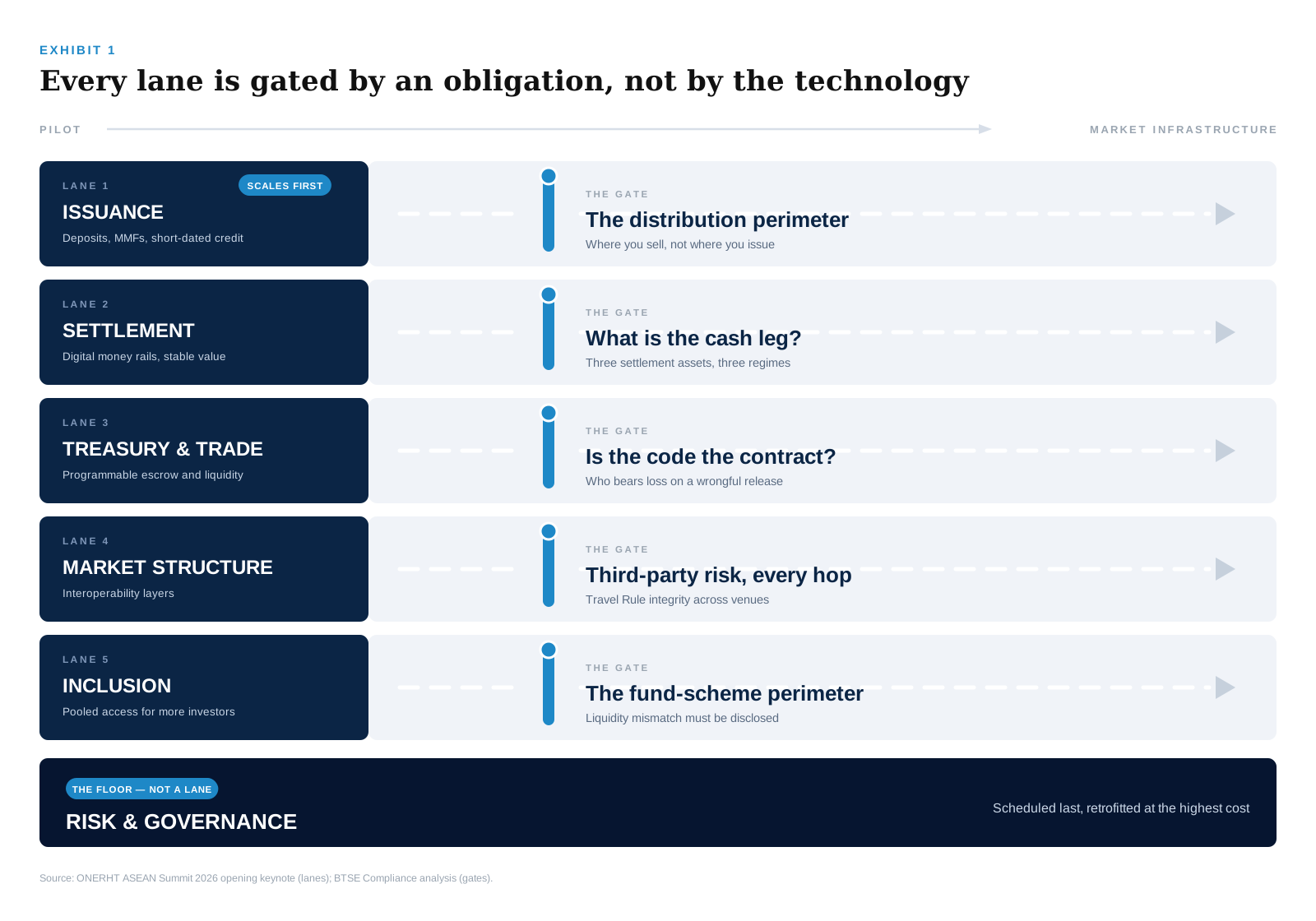
Take issuance. The question that determines feasibility is not whether a token can be minted but whether the instrument is a capital markets product in each jurisdiction it will be distributed into — not the one it is issued from. Offering and disclosure duties, investor-category limits and the identity of the authoritative register all follow from that answer.
Settlement is gated by the composition of the cash leg. A tokenised bank liability, a regulated single-currency stablecoin and an unbacked payment token attract three different regimes, with different reserve, redemption, segregation and disclosure duties. Then the harder question: is settlement final, and final against whom, when a counterparty fails?
Programmable escrow raises a question lawyers have not settled — whether the smart contract is the agreement or merely evidences one — and, more practically, who bears the loss when a conditional release fires wrongly. Interoperability layers import third-party risk on every hop, and Travel Rule data integrity across counterparties a firm does not control.
Which leaves the sequencing problem. Risk and governance sat at lane five. It is not really a lane at all; it is the floor beneath the other five. If issuance scales first and the control framework arrives fourth or fifth, the framework is being retrofitted onto live exposures — the most expensive order in which to build one.
But the map has a hole in it
"680mn people, one digital capital market" is a good aspiration. It is not yet a description of the regulatory perimeter, and the gap between the two is operational, not rhetorical.
The integration that is real is happening at the data and payments layer. ASEAN concluded negotiations on its Digital Economy Framework Agreement at the end of May 2026, with signing targeted for the 49th ASEAN Summit in November. DEFA covers digital trade, trusted cross-border data flows, payments interoperability, cybersecurity and digital ID. Separately, Nexus Global Payments was incorporated in Singapore in 2025 to govern the multilateral instant-payment scheme linking several ASEAN systems and India.
Both are meaningful. Neither is a capital-markets passport.
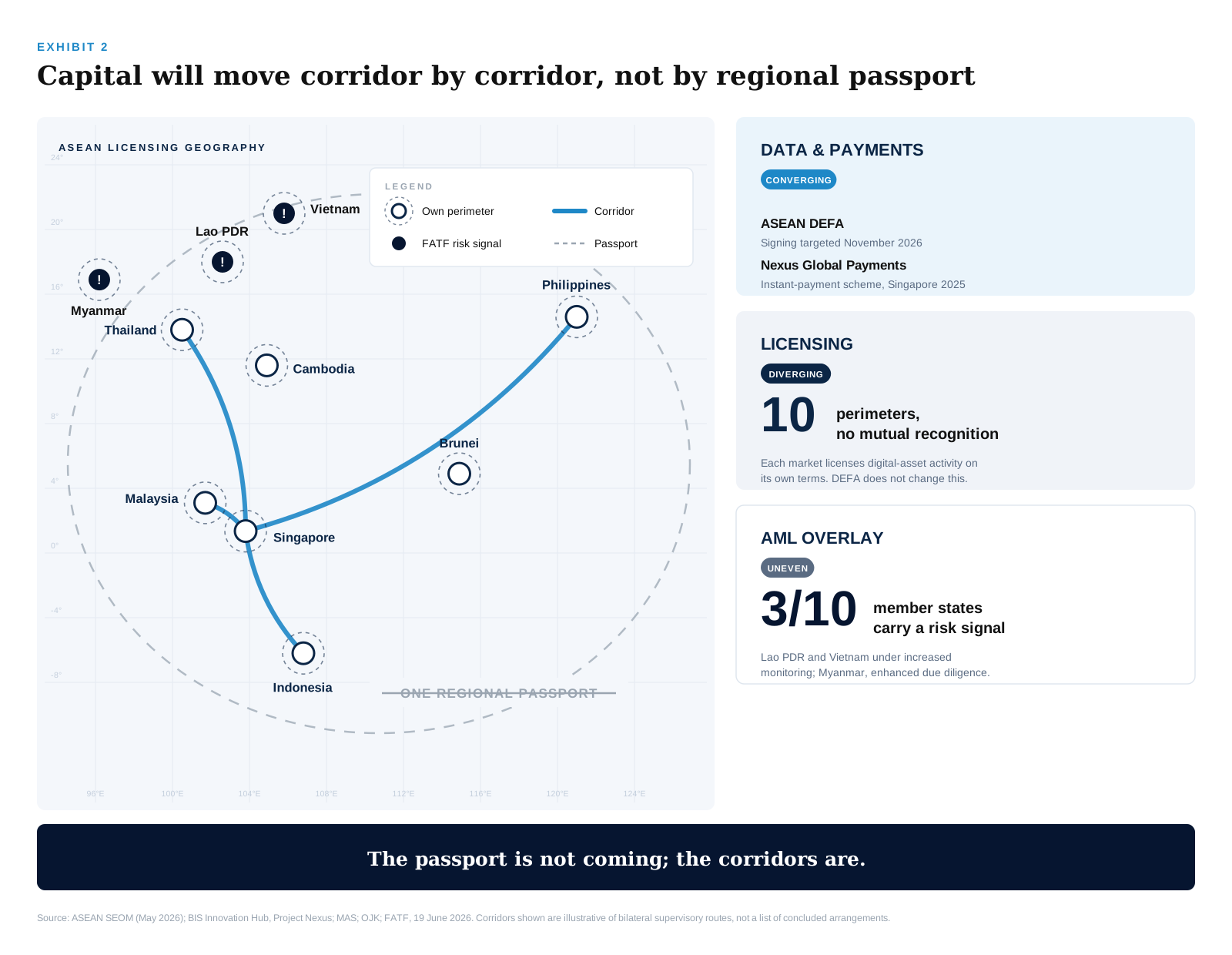
The licensing layer, meanwhile, is diverging rather than converging. Singapore's digital token service provider regime under Part 9 of the Financial Services and Markets Act 2022 took effect on 30 June 2025, with extraterritorial reach, no transitional relief and an openly high bar. Indonesia has completed the shift of crypto supervision from Bappebti to OJK and, following the 2026 amendments to its financial-sector omnibus law, now regulates digital financial assets inside the financial-sector architecture, with capital thresholds and mandatory client-asset segregation. Malaysia, Thailand and the Philippines each run their own perimeters. Vietnam has paired new statutory recognition with a restrictive market-access model for foreign participants.
The anti-money-laundering overlay is uneven too. After the Financial Action Task Force's June 2026 plenary, Lao PDR and Vietnam remained under increased monitoring and Myanmar remained subject to a call for enhanced due diligence. Three of ten member states carry a jurisdiction-risk signal that feeds directly into counterparty onboarding, correspondent access and country-risk scoring.
So capital will move more freely, but corridor by corridor, on the strength of bilateral supervisory comfort rather than regional fiat. Firms budgeting for a passport are budgeting for the wrong thing.
The scoreboard needs eight metrics, not four
The keynote closed on how success should be judged: time-to-settle down, operational error rates down, liquidity up, cost down — all delivered under sound governance.
Those are the right four commercial measures. But governance arrived as the qualifier at the end of the sentence, and in practice it is the binding constraint.
If tokenisation is going to be measured, the control side needs its own four, reported to the same forum on the same cadence. Time-to-intervene: the interval between a screening hit and an effective block, because a control that runs after settlement on an irrevocable rail is not a control, it is a reporting line. Travel Rule completion rate: the share of transfers with complete, validated originator and beneficiary data on first attempt, measured per counterparty, which is where interoperability failure shows up first. Segregation provability: not whether client assets are segregated but how many hours it takes to evidence it, on-chain and in the books, on a bad day. And recovery time for a verifiable ownership record, which is not the same as system recovery time — restoring the platform is not restoring an authoritative answer to who owns what.
If those four do not improve alongside the commercial four, the efficiency gain has not been created. It has been transferred — to the client, to the counterparty, or to the balance sheet on the day something breaks.
What This Means for Licensed Platforms
Five things are worth doing before the next pilot rather than after it.
Map product to permission at design stage, when the distribution perimeter is a constraint on the build rather than a remediation programme. Resolve the settlement-asset question first; most tokenisation projects that stall, stall on the cash leg. Treat interoperability as outsourcing, because every interconnected venue, bridge or shared-ledger participant sits in the resilience and concentration analysis whether or not a contract names it.
Then build the Travel Rule for the messiest counterparty on the network, since data quality is capped by theirs — design for the worst implementation and instrument the gap.
And write the wind-down before the launch. Recovery and resolution planning for tokenised positions — who can move keys, under what authority, and how a position is reconstructed — is materially harder than for book-entry assets, and regulators are increasingly asking for it up front.
Looking Ahead
The summit closed by asking whether ASEAN is ready to lead the next chapter of cross-border investment. On the evidence in the room, the direction of travel is not in doubt. Tokenisation does what its proponents claim, and the region's data and payments plumbing is being laid to carry it.
But compression cuts both ways. A market that settles in seconds gives its controls seconds to work. Sanctions screening, fraud interdiction and asset segregation do not get slower rails to run on simply because the money got faster ones.
Which is why the firms best placed for the shift from pilot to plumbing will not be those with the most ambitious pilots. They will be the ones that treated governance as lane one — and could prove it, on a bad day, in hours rather than weeks.